
What’s New About Today’s Ageing Consumers?

Ageing consumers are emerging as a $19 trillion market, reshaping spending, technology, healthcare and investment opportunities across the global economy. (Photo courtesy of Unsplash)
The world’s ageing population is emerging as a powerful force reshaping global consumer spending, creating a multi-trillion-dollar opportunity across healthcare, senior living, finance, tourism, technology, and consumer goods.
According to the World Economic Forum’s latest analysis, people aged 60 and over will control around $19 trillion of global consumer spending in 2026. Although they represent just 15% of the world’s population, they account for 27% of total consumer spending.
By 2036, spending by this group is projected to reach $34 trillion, meaning almost one in three consumer dollars globally will be spent by someone aged 60 or above.
The shift reflects two major demographic trends. Global life expectancy has risen from about 48 years in 1960 to 74 years in 2026, while fertility has fallen from 4.7 births per woman to 2.2. The population aged 60 and above has grown from 196 million in 1950 to 1.2 billion in 2025 and is expected to reach 2.1 billion by 2050.
A $4.5 Trillion Silver Economy
Beyond the purchasing power of older consumers, a specialized “silver economy” is developing around products and services designed for ageing populations.
The WEF estimates the market is already worth approximately $4.5 trillion and growing about 7% annually in real terms, more than twice the roughly 3% growth rate of overall consumer spending.
Senior living and care is the largest segment at about $1.3 trillion, followed by longevity health and longevity finance at roughly $900 billion each. Senior tourism represents another $800 billion, while retirement communities, lifelong learning and AgeTech account for about $600 billion.
The profile of older consumers is also changing. In the United States, 81% say they hope to age better than their parents, while 51% of people aged 60 and above say they feel younger than their chronological age.
That shift is creating demand for products supporting independence, vitality and healthier longevity rather than simply treating age-related decline.
AgeTech Opens New Investment Frontiers
Technology is becoming an increasingly important part of this transformation.
Adults aged 55 and over account for 34.5% of health and beauty buyers on TikTok Shop, challenging assumptions that older consumers are disengaged from digital commerce.
AgeTech is also expanding rapidly. Smart-home and ambient assisted-living technologies are growing about 17% annually, while fraud protection is growing 15%. Wearables and health-monitoring technologies, as well as regenerative medicine and cell therapies, are growing around 14%, while eldercare robotics and AI companions are expanding about 12%.
Much of this demand reflects the preference to age in place. Technologies that allow older people to remain independent at home while receiving health, safety and lifestyle support could therefore become increasingly important markets.
The opportunity extends beyond healthcare. Housing, insurance, financial services, travel, food, beauty and consumer technology are all being reshaped by longer lives.
US Leads as Asia-Pacific Accelerates
The United States illustrates the scale of the opportunity. Its 86 million adults aged 60 and over spend approximately $6.7 trillion annually, equivalent to the world’s third-largest consumer market if treated as a standalone economy.
Spending is also shifting toward social protection, medical products, hospitals, insurance and home ownership, while spending on restaurants, clothing and transportation declines.
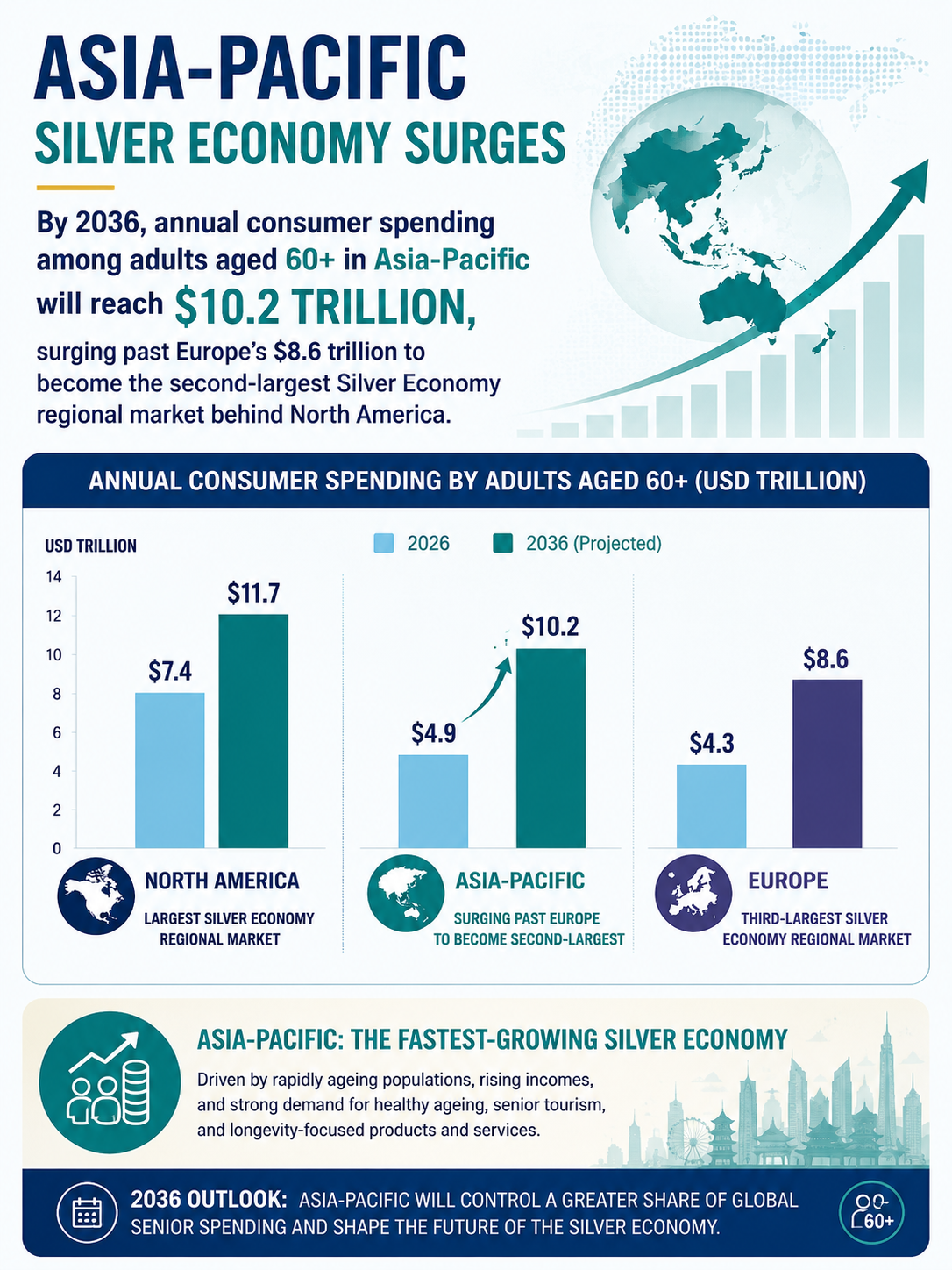
North American 60-plus spending is projected to rise from $7.4 trillion in 2026 to $11.7 trillion by 2036.
Asia-Pacific, meanwhile, is expected to become the fastest-growing silver economy. Spending by consumers aged 60 and above is projected to more than double from $4.9 trillion in 2026 to $10.2 trillion by 2036, surpassing Europe’s projected $8.6 trillion.
Japan, South Korea, China and Southeast Asia are expected to drive much of this expansion, particularly in senior tourism and healthy-ageing products.
For investors, the message is increasingly clear: ageing is no longer simply a demographic challenge for governments and healthcare systems. It is becoming a major consumer-market transformation.
As older consumers approach one-third of global spending within the next decade, companies and investors that adapt products, services and business models to longer, healthier and more digitally connected lives could capture one of the economy’s most significant structural growth opportunities.
Source: World Economic Forum
🚀 Connect with Global Leaders in Aging & Care Innovation!
Sourcingcares links international partners in aging care, long-term care, and health technology, fostering collaboration and driving solutions for a changing world. Our initiatives include Cares Expo Taipei, where the future of elder care takes shape!
🔗 Follow us for insights & opportunities:
📌 Facebook: sourcingcares
📌 LinkedIn: sourcingcares
📍 Explore more at Cares Expo Taipei!
