
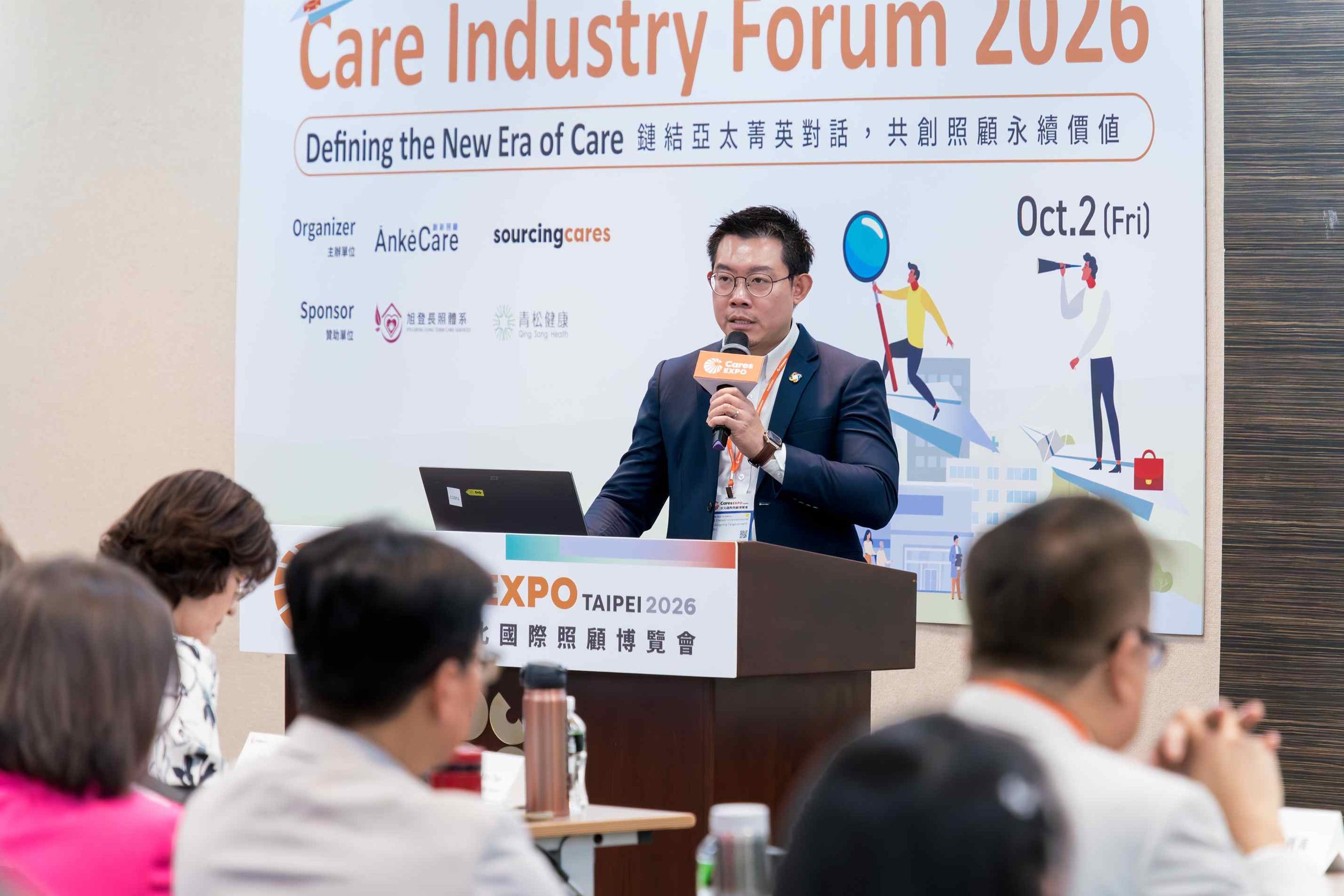
Dr. Gengpong Tangaroonsanti, Founder and CVO of Chersery Home International delivered a speech at ACIF 2026. (Photo courtesy of Cares Expo Taipei)
Thailand’s rapidly ageing population is creating new demand for nursing homes, rehabilitation, and community-based services, while the country continues to rely heavily on families to finance and provide long-term care.
At ACIF 2026, a concurrent event of Cares Expo Taipei, Sourcingcares interviewed Dr. Gengpong Tangaroonsanti, Founder and CVO of Chersery Home International, to explore the Thai elderly care market and how the care group is adapting its operating model to the sector’s growing challenges.
Nursing-home demand rises at home and abroad
Thailand’s universal healthcare system covers acute medical treatment, but routine long-term care remains largely self-funded. Families generally pay nursing-home and caregiver expenses themselves. Private insurers, including Muang Thai Life Insurance and Thai Life Insurance, have only recently introduced products covering certain long-term care needs.
Formal care, however, is expanding quickly. Tangaroonsanti said Thailand has around 1,100 licensed nursing homes, with facility numbers growing approximately 10–15% annually following the introduction of nursing-home licensing requirements in 2020. Yet more than 85% of long-term care remains home-based.
Changing family lifestyles are one driver. In Bangkok and other major cities, working family members increasingly struggle to provide full-time care for ageing parents.
“The demand of the nursing home is getting rising, especially specifically in the big city,” Tangaroonsanti said.
Another opportunity could come from overseas. Thailand wants to develop beyond conventional tourism into medical care, wellness, and long-stay retirement. Tangaroonsanti sees the country competing with Singapore and Malaysia for international retirees, arguing that Thailand can offer comparatively affordable care alongside larger living spaces, tourism, and hospitality. He noted that some Singaporeans, as well as retirees from Europe and the Middle East, could consider Thailand for longer-term living and care.
Chersery builds a continuum beyond nursing homes
Chersery has developed its business around three connected service lines: a long-term care and rehabilitation hospital, five nursing homes in Bangkok, and a home-care platform matching caregivers and skilled nurses with families. Its facilities provide around 200 beds, while its home-care operation serves approximately 80 families.
The model extends beyond accommodation. Chersery offers mobility services using wheelchair-accessible vehicles developed with Toyota and rents equipment such as oxygen generators, giving customers options ranging from residential and home care to transportation and supporting products.
For Tangaroonsanti, integration has a wider meaning.
“Integrated medical care is not just only integrated among the facility,” he said, arguing that care should integrate people, business models and families while addressing seniors’ physical, mental and spiritual needs.
Technology helps extend a limited workforce
Technology is becoming another pillar of Chersery’s operating model as Thailand faces shortages of care and rehabilitation professionals.
Tangaroonsanti said Chersery already uses bed sensors and remote vital-sign monitoring, while robotic devices support leg and upper-arm rehabilitation. Rather than replacing professionals, the technologies are intended to help limited staff serve more people. He said Thailand has only around 18,000 licensed physical therapists serving approximately 20 million seniors, making manpower alone insufficient to meet growing rehabilitation needs.
Chersery is also working with Taiwan’s FREE Bionics on portable rehabilitation technology. Tangaroonsanti sees potential to move robotic rehabilitation beyond care facilities and into homes, allowing patients to exercise more frequently without repeatedly traveling to clinics.
The group is also developing an AI voice-recognition system to identify signs of caregiver stress before shifts, allowing managers to adjust assignments when necessary.
But technology has to fit daily care operations.
“It should be simple. It should comply with the workflow,” Tangaroonsanti said, emphasizing local-language interfaces, usability and reasonable return on investment.
From facilities toward community-based care
The next stage could take Chersery—and Thailand—further outside traditional care facilities. Tangaroonsanti sees a shift toward decentralized healthcare, connecting hospitals, nursing homes, rehabilitation, home care, and eventually more community-based services.
Daycare centers are part of that direction. The Thai government is promoting community daycare, but Tangaroonsanti said the model remains in its infancy and around 99% of existing daycare centers are privately operated. Wider expansion will depend on reimbursement or another sustainable financing mechanism.
Location will be particularly important. Centers need to operate close to where families live and work, while their format may differ between Bangkok, Chiang Mai and rural communities. Tangaroonsanti envisions multidisciplinary teams combining preventive healthcare and senior activities with technologies such as telemedicine, while schools, volunteers and other community members could participate in activities.
“The concept is same—work located in the community,” he said.
This decentralized model fits his broader concept of lifespan, healthspan, joyspan and spiritual span—helping people live longer and healthier while maintaining happiness, peace of mind and purpose.
For Chersery, the direction is therefore not simply to add nursing-home beds, but to build an integrated, technology-supported care ecosystem stretching from hospital and rehabilitation to residential facilities, homes and communities. For Thailand, that evolution could also strengthen its position as an ASEAN destination for retirement, longevity and senior care.
🚀 Connect with Global Leaders in Aging & Care Innovation!
Sourcingcares links international partners in aging care, long-term care, and health technology, fostering collaboration and driving solutions for a changing world. Our initiatives include Cares Expo Taipei, where the future of elder care takes shape!
🔗 Follow us for insights & opportunities:
📌 Facebook: sourcingcares
📌 LinkedIn: sourcingcares
📍 Explore more at Cares Expo Taipei!
