
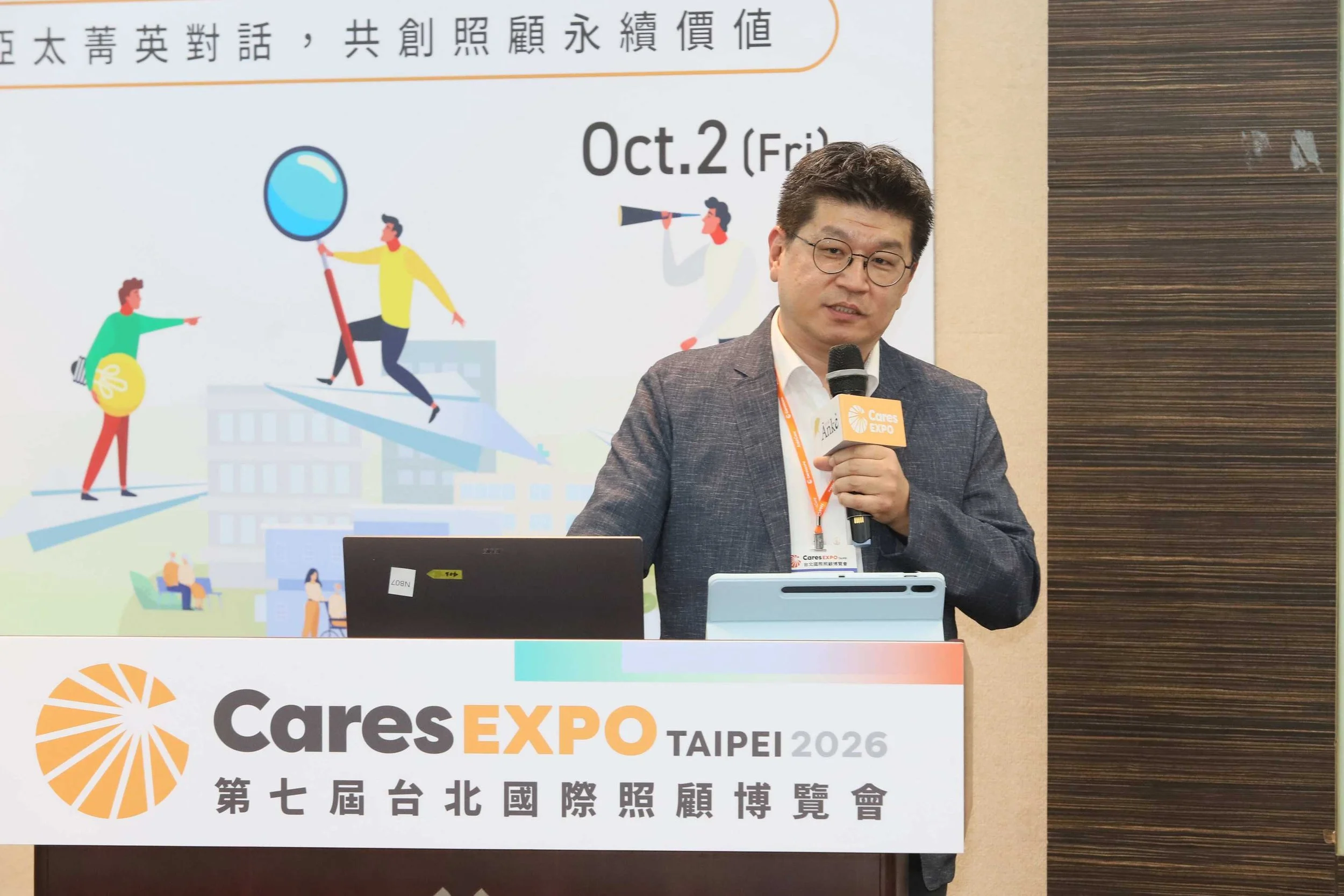
Hyun-Sik Choi, Director of Neutinamu Nursing Home in Anyang, South Korea, delivered a speech at ACIF 2026. (Photo courtesy of Cares Expo Taipei)
South Korea’s rapid aging is putting its long-term care system under mounting pressure, pushing policymakers and operators to rethink how care is financed, delivered and connected with medical and community services.
At ACIF 2026, held concurrently with Cares Expo Taipei, Sourcingcares interviewed Hyun-Sik Choi, Director of Neutinamu Nursing Home in Anyang, South Korea, to discuss the pressures reshaping Korea’s long-term care industry and how nursing homes are adapting to the country’s rapidly aging population.
South Korea became a super-aged society in December 2024, with more than 20% of its population aged 65 or older. It took the country only 24 years to move from an aging society, with 7% aged 65 or above, to a super-aged one—compared with 35 years for Japan, according to Choi. Around 10 million Koreans are now over 65, while approximately 1.15 million receive long-term care benefits.
Much of today’s system dates to the introduction of Long-Term Care Insurance (LTCI) in 2008. Previously, institutional care was largely a welfare service for low-income older people or those without family support. LTCI expanded access and helped nursing facilities grow from around 1,300 to approximately 4,500, with private operators accounting for about 80% of facilities, Choi said.
Fixed Pricing Puts Operators Under Pressure
The expansion has created a large care market, but its financing structure leaves nursing-home operators with limited flexibility as costs rise. Under LTCI, covered facility-care fees are determined through the national system rather than freely set by individual operators.
Choi said reimbursement increases do not necessarily keep pace with rising wages, food, energy and other operating expenses.
“Our costs are faster than our income,” Choi said. “We cannot make our price. The government sets the price for the long term care.”
Operators also have limited room to reduce labor costs. According to Choi, the required caregiver ratio has tightened from one caregiver per 2.5 residents in 2019 to 1:2.1, requiring Neutinamu to add three to four caregivers over time.
The wider workforce outlook adds pressure. Choi estimates Korea will need another 250,000 caregivers by 2030. Although around three million people hold caregiver qualifications, only about 600,000 currently work in the sector, with their average age already in the mid-60s.
Divided Systems Complicate Care Transitions
Another structural challenge is the separation between medical and long-term care. Nursing homes under LTCI primarily provide daily-living support, while long-term care hospitals operate under health insurance and provide medical treatment.
For example, if a nursing-home resident develops pneumonia, Neutinamu may need to transfer the person to a hospital. Even after the resident stabilizes, returning directly to the nursing home can be difficult, and the person may instead be transferred to a long-term care hospital.
For families, such transitions can mean more paperwork, costs and coordination between institutions operating under different systems. Continuity of information is another problem: Choi said nursing-home records are not always effectively incorporated into hospital care, while facilities may have to reassess residents and rebuild care plans when they return.
Hospital partnerships can ease some of these problems, but Choi believes shared care records and closer coordination are still needed. Korea’s development of home-based medical care could also help reduce unnecessary transfers, although he said the model remains at an early stage.
The direction also fits Choi’s broader view of the sector’s future: nursing homes could move beyond being a final destination for frail older people and increasingly connect residents and families with medical, long-term care and community services.
Neutinamu Looks for Practical Technology
Neutinamu’s evolution shows how operators are responding to these pressures. Established by Choi’s parents in 2004, before LTCI existed, it began as a 33-resident welfare facility focused on older people’s quality of life and rehabilitation. It has since expanded to 75 residents.
Technology is increasingly part of its response to staffing and administrative pressures. Moving documentation from paper to tablets has reduced time spent on records, administrative work and family phone calls, allowing caregivers to spend more time with residents.
Neutinamu is also testing AI-assisted fall detection using its existing CCTV infrastructure. Rather than requiring staff to continuously monitor cameras, the system analyzes footage and alerts them to potential falls. The facility is also exploring real-time vital-sign monitoring that could eventually cover all 75 beds, particularly for residents who require frequent checks.
But experience has made Choi cautious about adopting technology simply because it is available. Some assistive technologies previously tested at Neutinamu proved cumbersome in daily use or did not fit staff workflows. As a result, the facility increasingly evaluates technology according to whether it genuinely reduces frontline workload.
That approach is particularly important because around 80% of Neutinamu residents have dementia. The facility combines technology with recognition exercises, seasonal farming and other activities designed to connect residents with familiar experiences.
For Choi, the objective is not to automate care, but to give staff more time with residents. As he told the ACIF audience, “Technology should help caregivers not to replace them.”
Neutinamu’s experience reflects the broader challenge facing Korea: meeting rapidly growing demand will require more than additional beds. Sustainable financing, a stronger workforce, better medical-care integration and technology that works in real care settings will all shape the next stage of the country’s long-term care market.
🚀 Connect with Global Leaders in Aging & Care Innovation!
Sourcingcares links international partners in aging care, long-term care, and health technology, fostering collaboration and driving solutions for a changing world. Our initiatives include Cares Expo Taipei, where the future of elder care takes shape!
🔗 Follow us for insights & opportunities:
📌 Facebook: sourcingcares
📌 LinkedIn: sourcingcares
📍 Explore more at Cares Expo Taipei!
