
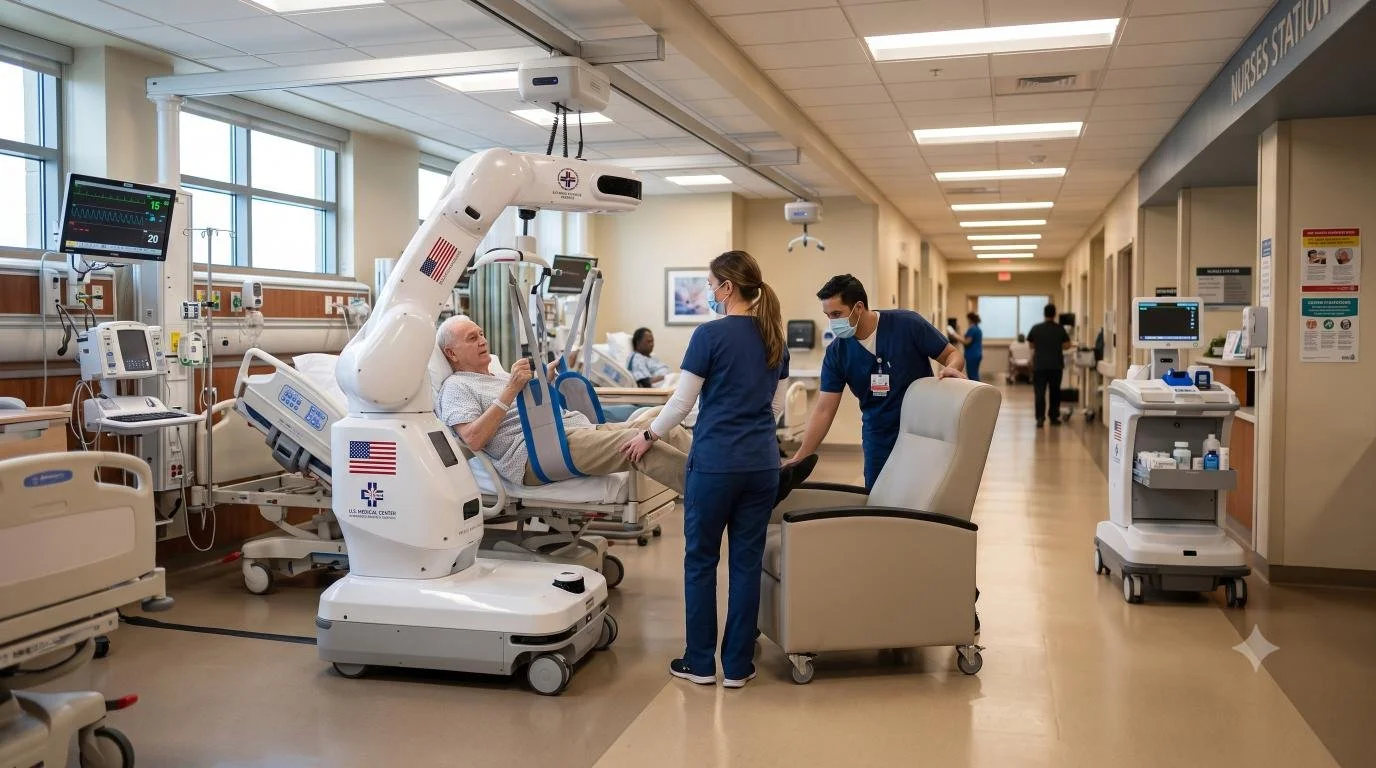
Patient-transfer and nursing-assist robots are rapidly expanding worldwide as healthcare providers tackle labor shortages through AI-powered automation and Robot-as-a-Service business models. (Stock Photo)
As hospitals and long-term care providers grapple with persistent labor shortages and rapidly aging populations, patient-transfer and nursing-assist robots are moving beyond pilot programs to become an increasingly important part of healthcare infrastructure. Once viewed as experimental technologies, these robots are now helping hospitals reduce staff injuries, improve workflow efficiency, and expand care capacity, creating one of the fastest-growing segments in healthcare automation.
Industry estimates value the global nursing robot market at between US$1.54 billion and US$1.9 billion in 2026, with projections reaching US$3.39 billion to US$4.2 billion by 2031, representing an annual growth rate of approximately 17% to 20%. The dedicated patient-transfer and nursing-assist robot segment alone is forecast to reach US$1.49 billion by 2036, highlighting growing demand for mobility support technologies.
The expansion is being driven by several structural trends. A projected global shortage of 4.5 million nurses by 2030, coupled with aging populations across developed economies, has placed mounting pressure on healthcare systems. Meanwhile, patient lifting remains one of the leading causes of musculoskeletal injuries among nursing staff, creating strong financial incentives for hospitals to automate physically demanding tasks. Advances in artificial intelligence, tactile sensing and human-robot interaction have also enabled robots to perform increasingly sophisticated clinical functions that were previously beyond their capabilities.
From Heavy Lifting to Hospital Logistics
Patient transfer remains the largest application for nursing robots. Automated systems now assist with bed-to-wheelchair transfers, lateral transfers between hospital beds and imaging tables, and mobility support for elderly patients. These solutions not only reduce caregiver injuries but also allow one caregiver to complete tasks that traditionally required several staff members. Bed-to-wheelchair transfers alone are expected to account for 38% of segment revenue by 2026.
Beyond patient handling, hospitals are increasingly deploying mobile robots to streamline routine logistics. Autonomous platforms transport medications, laboratory specimens and medical supplies, allowing nurses to spend more time on direct patient care instead of repetitive delivery tasks. Telemedicine robots have also gained traction by enabling physicians to conduct remote consultations, monitor vital signs and detect patient movement that could lead to falls in understaffed wards.
Real-world deployments demonstrate how rapidly these technologies are moving into everyday clinical operations. Able Innovations' ALTA Platform has been introduced at Lahey Hospital & Medical Center in Massachusetts to automate patient transfers. Diligent Robotics' Moxi robots have completed more than 300,000 pharmacy deliveries across hospitals in Texas, while Relay Robotics has expanded its delivery robots throughout BayCare Health System in Florida. Panasonic's Resyone robotic bed, which converts into a wheelchair, has been adopted by Sompo Care facilities in Japan, and Robocore's Dr. TEMI telemedicine robots have been deployed in Hong Kong public hospitals following earlier pilots in New York nursing homes during the COVID-19 pandemic.
Japan Leads Asia's Robotic Care Industry
Japan continues to dominate the patient-care robotics landscape, combining decades of industrial robotics expertise with one of the world's oldest populations. Panasonic remains among the pioneers in patient mobility, while RIKEN developed the high-profile Robear patient-lifting robot. Industrial automation leaders including FANUC, Yaskawa Electric, Omron, Denso Robotics, Hitachi and Fujisoft have also expanded into healthcare applications ranging from pharmaceutical automation to hospital logistics and patient-assistance technologies. Mitsubishi Electric supports the sector through robotics components and manufacturing capabilities.
Elsewhere in Asia, suppliers are rapidly expanding internationally.
Taiwan's Foxconn has entered the healthcare robotics market with Nurabot, an AI-powered nursing assistant that reportedly reduced nurse workloads by 30% during hospital pilot projects. The company is also manufacturing robots in Taiwan through its strategic partnership with Robocore, creating production capacity specifically for the U.S. market while helping customers diversify supply chains.
Robocore, leveraging manufacturing capabilities across Hong Kong, Taiwan and mainland China, has become one of the region's fastest-growing healthcare robotics companies. Its Dr. TEMI platform has been deployed in more than 15,000 units across 33 countries, serving hospitals and nursing homes through telemedicine, patient orientation, logistics and fall prevention applications.
China is also building a broad supplier ecosystem led by SIASUN Robot & Automation, whose portfolio includes intelligent beds, semi-automatic bed chairs and mobility aids exported to more than 30 countries. Other major Chinese companies—including Pudu Robotics, UBTECH Robotics, Shenzhen Zuowei Technology, Ecovacs Robotics and Shine Technology—are expanding globally as China develops international standards for elderly-care robots, strengthening its export competitiveness.
South Korea's healthcare robotics market is projected to grow at a 21% compound annual rate through 2036, supported by companies such as LG Electronics and rehabilitation technologies including Cyberdyne's HAL exoskeleton. Emerging suppliers in Thailand and India are also entering the market as demand spreads across Southeast Asia.
Robot-as-a-Service Gains Momentum
As adoption accelerates, vendors are also rethinking how healthcare providers purchase robotics.
Traditionally, hospitals invested through capital expenditure, with systems often costing between US$50,000 and US$500,000 per robot. Increasingly, suppliers are shifting toward Robot-as-a-Service (RaaS), allowing hospitals to subscribe to robotic capabilities for monthly fees typically ranging from US$2,000 to US$5,000.
Under the subscription model, vendors assume responsibility for maintenance, software upgrades, remote monitoring and staff training, enabling hospitals to deploy systems much faster while avoiding technology obsolescence. Some providers are also linking service fees to healthcare reimbursement generated through telemedicine, transforming robotics from equipment purchases into outcome-based services.
For investors, the transition could prove as significant as the robots themselves. As healthcare systems seek scalable solutions to chronic labor shortages, Robot-as-a-Service may lower adoption barriers for smaller hospitals and elderly care facilities, broadening the addressable market and accelerating the commercialization of nursing robotics worldwide.
Source: Mordor Intelligence, Future Market Insights, Able Innovations, Pharma Boardoom, RobotLab, Research and Markets
🚀 Connect with Global Leaders in Aging & Care Innovation!
Sourcingcares links international partners in aging care, long-term care, and health technology, fostering collaboration and driving solutions for a changing world. Our initiatives include Cares Expo Taipei, where the future of elder care takes shape!
🔗 Follow us for insights & opportunities:
📌 Facebook: sourcingcares
📌 LinkedIn: sourcingcares
📍 Explore more at Cares Expo Taipei!
