
ACIF 2026 Maps Asia-Pacific’s Next Care Transformation
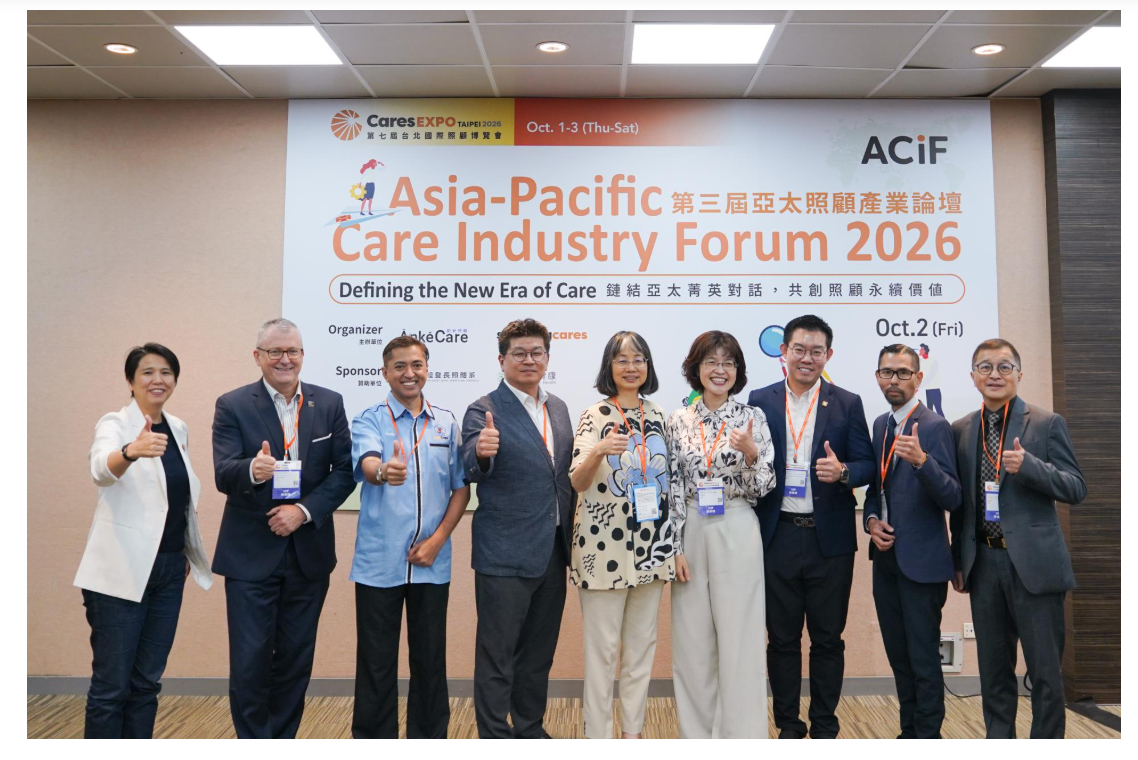
Speakers and industry leaders gather at the Asia-Pacific Care Industry Forum (ACIF 2026) during Cares Expo Taipei 2026. From left: Juihui Lin, Sales Director, Anke Media; David Moran, CEO, Southern Cross Care (SA, NT & VIC); Delren Terrence Douglas, President, AgeCOPE; Hyun-Sik Choi, Director, Neutinamu Nursing Home; Dr. Ching-Yi Wu, Associate Dean, College of Medicine, Chang Gung University; Dr. Kuei-Min Chen, Professor and Director-General, Department of Long-term Care, Pingtung County Government; Dr. Gengpong Tangaroonsanti, Founder and CVO, Chersery Home International; John Padama, CEO of Clinical Division, Eva Care Group; and Dr. Chia-Lun Chao, President, Yonghe Cardinal Tien Hospital. (Photo courtesy of Cares Expo Taipei)
The third Asia-Pacific Care Industry Forum (ACIF 2026), held on October 2 as part of Cares Expo Taipei 2026, brought together care providers, healthcare organizations, and industry leaders from six countries to examine how ageing populations are reshaping long-term care.
Speakers from the United States, Thailand, Taiwan, South Korea, Malaysia, and Australia highlighted common challenges: workforce shortages, rising operating costs, regulatory and reimbursement pressures, and growing demand for more integrated services.
Across these markets, a broader transformation is emerging. Care is moving beyond traditional institutional models toward integrated medical and long-term care, and community and home-based services. At the same time, AI, robotics, remote monitoring, and digital care systems are increasingly becoming part of everyday care operations.
US: Technology Responds to Workforce Pressures
John Padama, CEO of Clinical Division at Eva Care Group, highlighted how population ageing, workforce shortages, rising costs, and reimbursement pressures are reshaping the US long-term care market.
To address these challenges, Eva Care is integrating AI, remote monitoring, and robotics into daily operations. Its robots are designed to monitor vital signs, detect falls, dispense and deliver medications, support resident communication, and reduce repetitive staff tasks. Data can also be connected with electronic medical records to improve care coordination.
“It saves time and manpower and it lessens the mistakes,” Padama said.
His presentation demonstrated how automation could help operators rethink workflows as the industry faces pressure to expand capacity and maintain care quality with a constrained workforce.
Thailand: Integrating Care, Health and Wellness
Chersery Home International presented its integrated model connecting rehabilitation hospitals, long-term care facilities and home healthcare.
Founder and CVO Dr. Gengpong Tangaroonsanti emphasized that integration should extend beyond individual facilities. “Integrated medical care is not just only integrated among the facility,” he said.
Chersery is developing decentralized care supported by rehabilitation robotics, home-based technologies, and services extending beyond institutional settings.
Tangaroonsanti also introduced a wellness model built around four dimensions: lifespan, healthspan, joyspan, and spiritual span — helping people live longer, healthier and happier lives while maintaining a sense of purpose.
Looking ahead, Chersery aims to expand community care while contributing to Thailand’s development as a regional senior-care, wellness and longevity hub.
Taiwan: Connecting Hospitals, Communities, and Homes
As Taiwan advances into a super-aged society, Long-Term Care 3.0 is strengthening connections between medical and long-term care, including hospital-to-home transitions, reablement, dementia support, and smart care.
Dr. Chia-Lun Chao, President of Yonghe Cardinal Tien Hospital, demonstrated how hospitals can play a larger role in this evolving system.
The hospital has expanded beyond acute care into residential, community and home-based services. Multidisciplinary discharge planning connects patients with appropriate services after hospitalization, while smart technologies support care across different settings.
Its network aims to follow people through different stages of health and care needs rather than treating medical and long-term care as separate systems.
Chao summarized the approach as an effort to “use medical advances to support daily living.”
Korea: Nursing Homes Become Community Hubs
South Korea’s rapidly rising care demand is putting pressure on a long-term care system already facing workforce shortages, financial challenges, and fragmented medical and care services.
Hyun-Sik Choi, Director of Neutinamu Nursing Home, discussed the changing role of nursing homes under Korea’s 2026 integrated-care reform. Rather than serving primarily as facilities of last resort, he sees nursing homes developing into community hubs connecting older people with healthcare, long-term care, and local support.
At Neutinamu, AI-powered fall detection and digital care records help reduce staff workloads. Technology, however, is only part of its model.
With around 80% of residents showing dementia symptoms, Neutinamu combines dementia-friendly environments with music, gardening, reminiscence activities, and relationship-centered care, illustrating how technology can complement human-centered dementia care.
Malaysia: Expanding Capacity Beyond Institutions
Malaysia’s aged-care sector faces growing demand while formal capacity remains constrained by licensing complexity, workforce shortages, and limited investment.
Delren Terrence Douglas, President of AgeCOPE said only around 450 of Malaysia’s more than 2,000 care centres are licensed, while just 18 are nursing homes due to tougher requirements.
Douglas sees ageing in place as an important part of the country’s future care strategy. Rather than relying mainly on institutional expansion, he advocates helping older people remain healthy and independent at home for as long as possible.
He also called for greater international collaboration. Stronger home and community services could help delay institutionalization while reducing pressure on Malaysia’s limited residential care capacity.
Australia: Sustainability Under Regulatory Pressure
Australia’s aged-care operators face rising costs, workforce shortages, tighter regulation, and funding constraints.
David Moran, CEO of Southern Cross Care (SA, NT & VIC), said regulatory compliance has become a significant business risk, particularly for smaller providers facing increasing operating and administrative costs.
“We’ve probably got to a point where we’ve over-regulated a bit,” Moran said.
These pressures are contributing to industry consolidation as smaller providers struggle to maintain sustainable operations.
Southern Cross Care is responding through integrated care hubs combining retirement living, residential care, home services, fitness, and dementia respite. It is also investing in prevention, workforce retention, digital care systems, and data-driven technologies to strengthen operational sustainability.
From Facilities to Connected Care Ecosystems
Despite different financing systems, regulations and levels of market development, the six countries represented at ACIF 2026 revealed several shared directions.
Care is increasingly moving beyond individual facilities. Taiwan is strengthening medical and long-term care connections; Korea is expanding the community role of nursing homes; Thailand is linking rehabilitation, long-term care, home healthcare and wellness; Malaysia is looking toward ageing in place; and Australia is building integrated service hubs.
Technology is also moving closer to frontline operations. AI, remote monitoring, robotics, fall detection, digital records, and rehabilitation technologies are increasingly being applied to workforce and service-delivery challenges rather than introduced simply as standalone innovations.
The discussions at ACIF 2026 pointed toward a care industry increasingly built around connected networks of medical, long-term, community and home-based services. As ageing accelerates across the Asia-Pacific, the challenge will not simply be adding more care capacity, but developing sustainable systems that connect policy, people, technology and services while enabling older adults to receive appropriate care wherever they live.
🚀 Connect with Global Leaders in Aging & Care Innovation!
Sourcingcares links international partners in aging care, long-term care, and health technology, fostering collaboration and driving solutions for a changing world. Our initiatives include Cares Expo Taipei, where the future of elder care takes shape!
🔗 Follow us for insights & opportunities:
📌 Facebook: sourcingcares
📌 LinkedIn: sourcingcares
📍 Explore more at Cares Expo Taipei!
